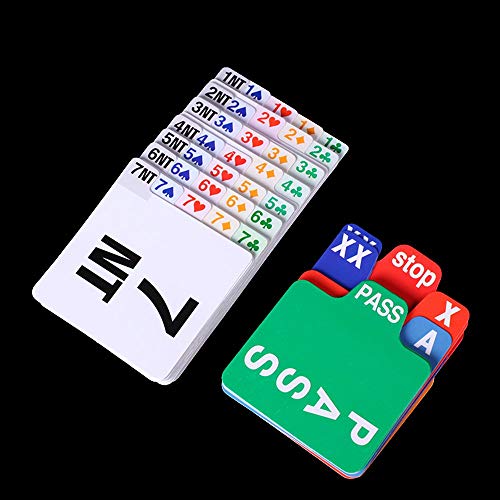
If you went ahead with my advice from the end of Lesson 1, you already have the first deals under your belt. If you haven’t – I encourage you to take a step back and hop on BBO to play some deals. It’ll provide a good context for this lesson, in which I aim to resolve some ambiguity with regards to bidding basics and hand evaluation.
… Welcome back! Now that I am safe to assume you have played some deals, we can dive in. I’m guessing that you’ve experienced a fair share of confusion already, especially when bidding. The deal starts, you get your cards and.. now what? You know your hand, you know which cards are strong, but you can’t tell whether your hand is strong as a whole. The skill of evaluating your hand will give you some footing in this situation. You’ll learn how to assess the strength of your hand and, over time, you’ll learn how to act about it.
Note: From now on we’ll use a specific, but very intuitive, notation to describe a hand. It may look something like:
♠AQxx ♥Kxx ♦xxxx ♣J10.
Note that the x character stands for the spot cards – numbered cards ranking below 10. We don’t usually distinguish between them, since their exact value is irrelevant most times. In this example the hand consists of the ace and the queen of spades and two spade spot cards, the king of hearts and two small hearts, four spot cards in diamonds and a jack and a ten in clubs.
Hand evaluation
There are two main factors that constitute the strength of your card – the high cards and the suit distribution, i.e. the split of the cards between the suits.
Obviously, the higher the cards and the more of the strong cards, the stronger your hand is.
As for the distribution, as a rule of thumb, the more imbalanced a hand is, the more potential it holds. For example, a hand
♠AKQJxx ♥A ♦xxx ♣xxx
holds more potential than
♠AKQJ ♥Axx ♦xxx ♣xxx.
Assume we play a no-trump contract. With the first hand it’s very likely we’ll be able to take 6 tricks in spades. As we play the high spades, the opponents’ spades will most likely all be played and consequently the two small spades will be cleared to win tricks. With the second hand, we’ll only take 4 tricks in spades and it’s unlikely the small cards in other suits will take any tricks.
Note: Something you might have already noticed – it’s preferable if your high cards are in your long suits.
We have the intuitions. Now let’s make them more concrete and actionable. In bridge we use the measure of high card points (HCP), which allows us to put a number on the strength of the card. It’s a very simple system and is used by players of all levels.
For each high card in your hand we add a set number of points:
- for an ace: 4 points,
- for a king: 3 points,
- for a queen: 2 points,
- for a jack: 1 point.
You simply add them up and there it is – your total number of HCP.
Example 1: With the hand of
♠Axxx ♥Qx ♦xxx ♣Jxxx,
we have 7HCP: 4 (for the A♠) + 2 (for the Q♥) + 1 (for the J♣).
Example 2: The hand is
♠x ♥AKQJxxx ♦Qxx ♣xx.
In this example we have 12HCP: 10 in hearts (4+3+2+1) and 2 in diamonds.
Pro tip: Some players are cautious when counting points for say a single queen or a jack, especially in opponents’ suits. The odds of these points taking a trick are low in this case.
Note that there is 10 HCP total in each suit (4 for the ace + 3 for the king + 2 for the queen + 1 for the jack) and 40 HCP total between all players. Therefore having more than 10 points is already an above-average card.
However, as I mentioned earlier, the high cards are not the only thing that matters in evaluating your hand. We’ll also take into account the distribution – the split of the cards between the suits.
Especially when bidding a trump contract, we might add some points for unbalanced hand to the total. We call these the distributional points:
- 2 points for a void (no cards in a suit),
- 1 point for a singleton (one card in a suit),
- +1 point for every card over 5 in a suit.
Some players skip the distributional points when evaluating their strength. That is especially the case for the splinters (a void or a singleton) when considering a NT contract or when your partner bid that suit.
I suggest for now you take these with a healthy dose of scepticism and focus on high card points.
Opening basics
We’ll now introduce our first strategy for bidding – a startegy if you will. It’ll be a base that we’ll expand on over time. A base that is shared between all widely used bidding systems.
Let’s start with opening the bidding – playing the first non-pass bid (or the first bid between you and your partner). We’ll set the following rules:
- if you have at least 12 points and a 5-card suit – open 1 in that suit,
- if you have at least 15 points but no 5-card suit – open 1NT.
Note that to open 1NT we need a stronger hand. That is because it’s simply harder to take many tricks without a long, dominating suit. As mentioned before, if you and your partner have many cards in a suit, it’s very likely that weak cards of that suit will take some tricks.
Let’s apply these rules in the following examples.
Example 3: The hand is
♠Ax ♥AQJxxx ♦xxx ♣Jx.
We have 12 HCP and 6 hearts. We open 1♥.
Example 4: The hand is
♠xx ♥AQJxx ♦xxxx ♣Jx.
We have 8 HCP. Even though we have 5 hearts, we don’t have enough points to open 1♥. Therefore, we pass.
Example 5: We get
♠AJ ♥xxxxx ♦AKQxx ♣x.
We have 14 HCP plus an extra distributional point for the singleton. We can definitely open. Our options are 1♦ and 1♥. Let’s take a look at these suits again – we have three high cards in diamonds and nothing interesting in hearts. Because of the quality of the suits, we go with 1♦.
Example 6: We have 12 HCP and no 5-card suits:
♠xxx ♥AQJx ♦Axxx ♣Jx.
We cannot open in a suit, since we don’t have a 5-card suit. We cannot open 1NT either, since we need 15 points for this opening. Even though we have a nice hand, we have to pass.
Responses
Now that you and your partner know how to open, we need learn how to react. We’ll take two factors into consideration: the number of points in your hand and whether you have a fit in the suit your partner bid. A fit in a suit are the cards your partner needs for the two of you to have 8 cards in a suit. So if a partner opened 1♥, meaning he has 5 hearts, you need at least 3 cards to have a fit. If you have only one, you don’t have a fit in hearts.
The strategy will be as follows:
- if you have below 7 points – pass,
- if you have at least 7 points
- … and your partner opened a suit
- … and you have less than 3 cards in that suit – respond 1NT,
- … and you have at least 3 cards in that suit – raise to 2 in that suit
- … and your partner opened 1NT
- … and you don’t have any 5-card suit – raise to 2NT
- … and you have a 5-card suit – respond 2 of that suit
- … and your partner opened a suit
Example 7: Our partner opened 1♥. The opponents pass. We have
♠xxxx ♥Jxx ♦AQxx ♣Jx.
We have 8 points and a fit in hearts (our partner has at least 5 hearts, to have 8 between us two we need 3). We can raise to 2♥.
Example 8: Our partner opened 1♣. The opponents pass. Our hand is like previously
♠xxxx ♥Jxx ♦AQxx ♣Jx.
We have 8 points but this time we don’t have a fit in clubs. We bid 1NT.
Example 9: Our partner opened 1NT and our opponents pass. We have
♠xxx ♥Jxx ♦Axxx ♣Jxx.
We need 7 points to respond, but we only have 6. We pass.
Key points from this section
- You need 12 points and a 5-card suit to open the bidding with 1 of the suit.
- You need 15 points and a balanced hand to open 1NT.
- You need 7 points to respond to your partner’s opening.
- When responding to your partner opening, you need 3 cards in the suit they bid to raise his bid in that suit.
- If you don’t have 3 cards in your partner’s color but you have at least 7 points, respond 1NT.
Further bidding
We laid down the strategy for opening, and an immediate response to an opening. But what happens next? This section aims to shine some light on that part. This time however, the strategy will be less concrete and more general – after all there’s a plethora of possibilities – unorthodox hands and opponents’ interventions. This section aims at setting basic intuitions that we’ll build on in the future.
The goal of the following bids will be to get used to exchanging information with your partner and finding your combined strength (HCP) and number of cards in the trump suit. In the next lesson, I’ll finally explain why showing your hand as precisely as possible matters and how it translates to the score in the game of bridge.
The challenge is in exchanging relevant information with the partner while managing the risk. We cannot go on carelessly raising the bids, bringing the contract too high for it to be winnable.
I’ll provide you with a general guideline you can use to decide what to do after the initial round of bidding.
If you have the minimum of your hand – pass
If you find yourself bidding, and you already have shown everything of interest – simply pass. For example, you opened 1♠ with 12 points and exactly 5 spades, your partner responds 2♠. In this situation there is nothing extra in your hand your partner doesn’t yet know about. In this case you pass.
Example 10: You have
♠xxx ♥KQx ♦AQJxx ♣Jxx.
You open 1♦, your partner responds 1NT. What do you do now? Your partner expects you to have 12 points and 5 diamonds. You have one extra point. Is this enough to bid again? I’d say no, it’s time to pass.
Example 11: You have 12 points and 5 spades:
♠AQxxx ♥Qxx ♦Axx ♣xx.
You open 1♠, the opponent passes and your partner raises to 3♠. We’ll get to that later but in this case you can expect your partner to have something more than a simple response – maybe they have extra spades or 11 points. However, we have the minimum of what we promised. We pass.
If you have a strong hand – bid again
Let’s look at another scenario – you have 16 HCP and 5 spades. You open 1♠, your partner responds 2♠. You still have extra points in your hand that your partner doesn’t know about. You can bid again and say 3♠.
Example 11: Your hand is
♠KJxxx ♥Kx ♦AQJxx ♣x.
You open 1♦, since you like your diamonds more than your spades. Your partner responds 1NT. You have 2 extra points (you have 14 rather than 12 your partner expects), an imbalanced hand and another long suit. You can bid 2♠.
Example 12: This time you receive:
♠xxxxx ♥AK ♦AQJxx ♣x.
You once again open 1♦. Your partner bids 1NT. Should you bid 2♠ like in the previous example? I’d say no, even though you have the same distribution and number of points. This time the spades are nothing to write home about and you have only 2 extra points. You can pass.
I imagine the previous two examples might have been a little confusing. I wanted to show you that the number of points and the distribution is not everything when evaluating a hand. If you decided to act differently than I suggested in the previous two examples – that’s ok. As mentioned before, for now we’re dealing with relatively flexible guidelines and you need to use your forming judgement.
Example 13: Let’s switch things around a little. This time your partner opened 1♥. Assume the opponents just keep passing in this auction. You have
♠xxx ♥AQx ♦AJxxx ♣x
and you respond 2♥. Your partner raises to 3♥. We know they have a hand stronger than 12HCP and 5 hearts. We also have some extra we still haven’t communicated. We can bid 4♥.
If you have a very strong hand – jump
There’s another option we haven’t discussed yet. When we raise our partner’s bid, we can raise it by more than one. We can respond 3♦ to our partner’s 1♦ opening. We just have to have some agreement what such jump would mean. For now, we’ll jump to show the strength of our card. If our hand is noticeably stronger than what a minimum raise would communicate, we will jump.
Pro tip: You can also apply these rules to your openings – have a strong hand with 5 hearts? You may consider opening 2♥.
As time goes on and you make progress learning bridge, these vague guidelines will transform into a very concrete bidding system – a set of well-defined and way less ambiguous bidding rules you agreed on with your partner.
Practice
In the practice after this lesson I want you to focus on explaining your hand to your partner through your bids, while also trying to understand your partner’s hand. Play around with the guidelines I gave you and see how well you understand each other.
If you’re playing alone on BBO, you can always check your partner’s hand after the deal is over.
Good luck and have fun!
 Ruffing Spades
Leave a comment